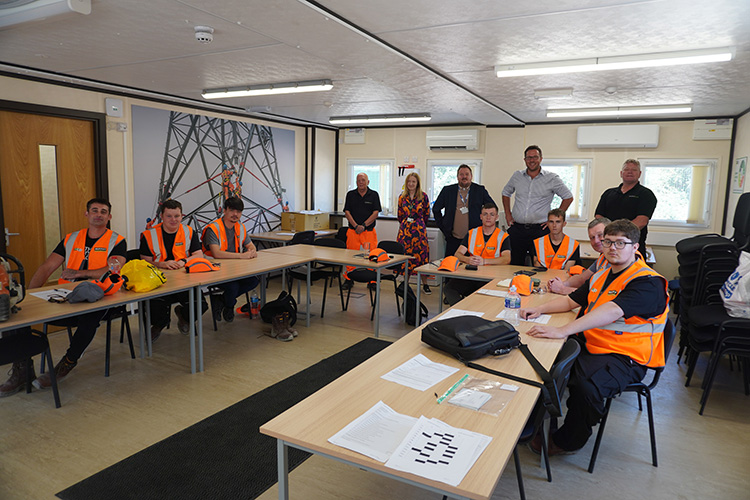
A successful Sector Entry Pilot delivered by Murphy, the Department for Work and Pensions and Energy & Utility Skills has created new pathways into skilled construction and infrastructure careers.
All eight participants completed the two-week programme, consisting of on the job training, CV writing and interview practice, achieving a 100% completion rate. Six have since joined Murphy as Operative Level 4 employees, with four expected to undertake groundworker duties on projects and two supporting wider activity at Murphy’s Energy Transmission Training School in Ollerton, Nottinghamshire.
All participants were referred to the programme by their local DWP work coach.
The pilot combined targeted employment support with practical, industry-recognised training, helping participants develop the skills, qualifications and confidence needed to begin working in construction and infrastructure roles. The training included EUSR registration, providing participants with recognised and transferable credentials that can support longer-term employment across the industry.
Dawn Moore, Group People & Communications Director at Murphy, said:
“The whole purpose of the programme is to work nationally with the Department for Work and Pensions, along with Energy & Utility Skills, to address the ongoing sector skills shortage, ensuring support for critical projects over the next few years and beyond.
“The people who go through the programme will finish with a wide portfolio of accredited training that will enable them to find work with any construction employer in the UK.”
The pilot forms part of a wider programme of sector entry activity designed to attract people from new and underrepresented talent pools and create supported routes from unemployment into skilled work.
It also contributes directly to the Attract and Develop pillars of the Skills Strategy 2025–2030. The strategy identifies a need to recruit and develop more than 312,000 people across the energy and utilities sector by 2030 to support critical infrastructure, the energy transition and net zero.
Sector entry programmes provide one practical response to this challenge. By bringing together employers, government and the sector skills body, they can help remove barriers to employment, give participants recognised skills and enable employers to access new sources of talent.
Stephen Barret, Director of Membership & Strategic Engagement, Energy & Utility Skills, said:
“This pilot demonstrates the value of employers, government and industry working together to address workforce challenges and create new opportunities for people seeking a route into skilled employment. The results show what can be achieved through targeted support, recognised training and clear pathways into work.
Programmes like this will play an important role in widening participation, accessing new talent pools and building the workforce needed to deliver critical infrastructure and support the energy transition for the future.”
The Murphy pilot builds on earlier sector entry activity delivered with employers including M Group and Laing O’Rourke. Across the three pilots, 21 people have completed training and gained new skills, with 17 moving into employment, equivalent to an 81% job-start rate.
Energy & Utility Skills is now working with its partners to capture participants’ experiences and explore how the sector entry model could be expanded across more employers and locations.
Interested in exploring future sector entry activity? Contact Energy & Utility Skills at collaborate@euskills.co.uk